A Small Table Display for Sharing Work in Progress
A small table display for sharing work in progress helps visitors compare versions, notice choices, and leave useful responses without turning a draft into a show.
A small table display for sharing work in progress works best when each object gives visitors a clear way to look, compare, and respond. The aim is not to make unfinished work look finished. It is to let people see what is changing and offer comments the maker can actually use.
Imagine that Lena, an invented printmaker and writer, has been making small paper landscapes alongside short captions. She wants feedback from a few friends at a neighborhood studio gathering, but she does not want a formal critique or a polished exhibition. Her table has room for a modest selection, a chair nearby, and enough space for people to pause without blocking the room. The display she assembles is designed around one question: which relationship between image and caption feels most alive?
Begin with one question
A table becomes easier to read when its contents point toward a single kind of attention. Lena does not ask visitors to judge the whole project, explain what it means, or decide whether it is ready. She wants to learn how image and text influence one another.
That question guides what goes on the table. She chooses three pairs of landscape prints and captions: one pair that feels settled, one that is changing, and one that still surprises her. She leaves out unrelated sketches and notes. Those might be useful in another conversation, but here they would dilute the comparison.
Before arranging anything, write the question in plain language. If you cannot say what kind of response would help, narrow the display before inviting anyone to browse. “Which caption changes how you read the image?” gives visitors a more useful direction than “What do you think?”
Make versions legible
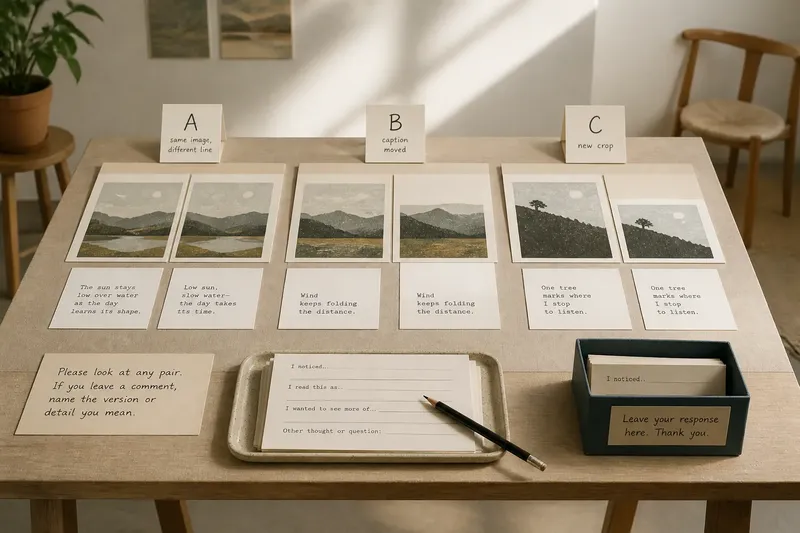
Visitors need to understand what they are comparing without having to guess the order or handle delicate work. Lena lays each print beside its caption, then groups the pairs from left to right. She uses small folded cards to mark them “A,” “B,” and “C,” and writes a brief note under each card: “same image, different line,” “caption moved,” or “new crop.” The notes describe a change, not a verdict.
She keeps the original order visible with a simple paper strip placed behind each group. A loose stack of extra versions would invite rummaging and make it hard to tell which object belongs where. Instead, she puts two versions in each group, aligned along the lower edge, so the differences are easy to spot while the work remains separate.
For a writing project, a printed paragraph can sit beside a revised paragraph, with changed sentences marked lightly in pencil or shown in a second copy. For an image sequence, use consistent backing sheets and keep the same viewing orientation. The useful comparison is often the change itself; elaborate labels and decorative props do not make it clearer.
Set a welcoming pace
A display should allow a visitor to browse quietly before speaking. Lena leaves open space between the three groups and places a few chairs nearby, not directly in front of the table. She puts a pencil and response slips at one end, where they are easy to find but do not interrupt looking.
Her note to visitors is short: “Please look at any pair. If you leave a comment, name the version or detail you mean.” This makes written responses optional and specific. It also tells people that they do not need to produce an expert critique to be helpful.
She does not ask everyone to gather around at once. A group discussion can be lively, but it can also make quieter visitors follow the first confident opinion. A table suits a slower exchange: someone can notice a detail, write it down, and move on without having to perform a reaction for the room.
What is not worth the effort? A decorative theme, matching stationery, or a long explanation of the project’s backstory. If visitors need a speech before they can begin, the display is carrying too much context. A title, a brief orientation note, and a focused question are usually enough.
Invite useful responses
Lena’s slips offer three prompts: “I noticed…,” “I read this as…,” and “I wanted to see more of….” These invite observation and interpretation without asking visitors to solve the work for her. She includes a blank line for a question or other thought, but does not require anyone to fill in every prompt.
She also places a small box beside the slips. A visitor can leave a response without attaching it to a particular version in public. On the slip, the visitor can identify the group with its letter. That small detail matters: “I like B” is less useful than “In B, the line about wind makes the dark shape feel like a hill.”
Say you are sharing two versions of a short scene, and one friend says, “The first one is better.” You could ask, “What did the first one help you understand?” That follow-up invites a concrete observation without arguing for the version you prefer. The friend might mention the character’s hesitation, giving you something to consider during revision rather than a command to obey.
Keep feedback within the scope of your question. If you are comparing captions, comments on paper color may be interesting but are not the main information you requested. You can acknowledge them, then return to the distinction you hoped to learn about.
What should visitors know?
Should every version be shown?
No. Choose versions that make a meaningful comparison, and keep the rest nearby but off the table if you may need to consult them. A focused selection helps visitors notice changes rather than sort through the project’s entire history.
How much context belongs on the table?
Give enough context to identify the work and understand the comparison, but save the longer story for a conversation if someone asks. A concise note can name the materials, the stage of the work, and the question guiding the display.
What if visitors disagree?
Let the disagreement remain visible without asking the group to settle it. Different responses can show how a choice reads in more than one way; you can decide later which interpretation matters to the work.
Should comments be anonymous?
That depends on the room and your comfort. Anonymous slips may make candid responses easier, while signed notes let you ask a follow-up; offer a simple choice rather than making either approach compulsory.
Read the result carefully
When the gathering quiets, Lena does not count which version received more praise. She gathers the slips and sorts them by the letter visitors used. Then she marks recurring observations separately from one-off reactions and questions. A repeated note may reveal a pattern, but a single precise response can also point to something she had overlooked.
She notices that people describe the same caption as “calm” beside one print and “wary” beside another. That contrast gives her a new question: perhaps the images are doing more of the emotional work than she expected. She does not revise on the spot. She writes the observation in her notebook and looks again the next day, when the visitors’ voices are no longer in the room.
Responses are information, not instructions. If a comment conflicts with the direction you want, you can set it aside; if it repeats a confusion you care about, examine the work for the source of that reading. The maker remains responsible for deciding what to keep.
Carry the display forward
After the conversation, Lena records what she learned about the relationship between image and caption, then notes one small revision to try. She keeps the visitors’ words separate from her own decisions, so a suggestion does not become mistaken for an obligation. The prints return to their folders, but the comparison has given the next session a clear starting point.
For your own small table display for sharing work in progress, choose a question, show only the versions that help answer it, and make the route through them easy to follow. A considerate response can be brief; the value lies in its specificity. Leave room for visitors to look without speaking, and leave room for yourself to decide what their attention means.