Index Cards for Writing Scenes: Build a Sequence That Holds Together
Index cards for writing scenes help you trace cause and consequence, compare scene order, and spot missing links before the sequence reaches the page.
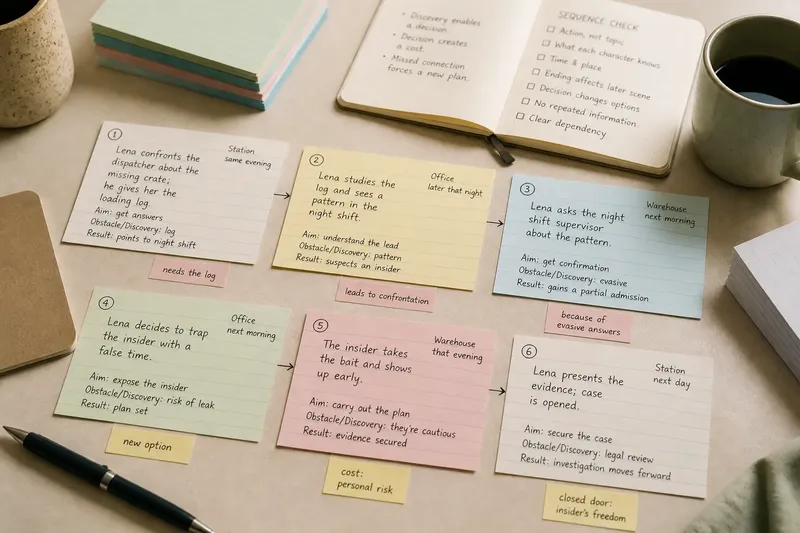
Index cards for writing scenes can reveal whether one event truly causes the next, not just whether the events can be arranged in a tidy row. Give each card a specific change and a reason the following scene begins, and the sequence becomes easier to examine.
This method is especially useful for tracing story logic across time, place, and point of view. A scene card is not a miniature draft; it is a record of what changes and what that change makes possible or necessary afterward. That distinction keeps the cards focused on connections rather than prose polish.
Record causal links
Write the event on each card in a way that makes its consequence visible. “Argument at the station” leaves the connection unclear. “Lena confronts the dispatcher about the missing crate; he gives her the loading log, which points her toward the night shift” records both the action and the next lead.
For each card, note three things: the character’s immediate aim, the obstacle or discovery, and the result that matters later. If a result does not affect another scene, it may still belong in the story, but the card should not pretend it drives the next event.
Use a short arrow or a few words to name a dependency: “needs the log,” “because the meeting was canceled,” or “same evening as the storm.” This is more useful than numbering every card, since the point is to make the reason for an order visible.
Track time and place
Order can fail for reasons that have little to do with plot. A character may be in two places at once, a message may arrive before it was sent, or a scene may rely on someone knowing a fact they have not learned yet. Add a time or location note when it helps catch one of these continuity problems.
Keep the notation simple. Write “next morning” or “train platform” only where the detail affects neighboring scenes. If a scene can move without changing time, location, or what characters know, it probably does not need extra logistical notes.
When two scenes appear to conflict, compare what each character knows at the start and end of both. If the later scene assumes information that is absent from the earlier one, decide whether to move a scene, add a moment of communication, or change what the character knows.
Mark turning points
Cards can also show how a character’s options change. Mark a decision, reversal, discovery, or loss when it alters what the character can do next. A sequence of scenes may be orderly but still feel repetitive if every card leaves the character with the same choices.
Try a simple margin mark: “new option,” “cost,” or “closed door.” Use words rather than a complex color code, so the meaning remains clear if cards are moved or shared. The marks are there to help you compare the shape of a sequence, not to classify every detail.
Test a scene move
Suppose you have four cards: “Ari finds a key in the rehearsal room”; “Ari asks the caretaker about it”; “the caretaker denies recognizing it”; and “Ari uses the key to open a locked costume trunk.” You want the trunk scene to come first because its discovery feels exciting.
Read the dependencies before moving anything. The trunk scene requires the key, so it cannot precede the discovery unless you change how Ari gets inside. The caretaker’s denial also depends on Ari showing or describing the key. You could keep the order, or rewrite the trunk card so Ari finds the key inside the trunk; that would change the discovery and remove the caretaker scene’s current purpose. The resulting choice is concrete: preserve the existing chain, or revise the cause and consequence across the sequence.
Use a sequence check
- Check whether each card names an action rather than a topic; if it only says “family tension,” write the event that creates the tension, or keep it as an unresolved question rather than treating it as a scene.
- Check what the viewpoint character knows at the start of each scene; if they lack information the scene assumes, add a delivery or discovery, or revise their knowledge.
- Check the time and place against adjacent cards; if the movement is impossible or unclear, add a transition or change the order.
- Check whether the scene’s ending affects a later card; if no consequence follows, connect it to a later event or reconsider its role in this sequence.
- Check whether a decision changes the character’s available options; if the next card ignores that change, revise the next action or alter the decision’s consequence.
- Check repeated cards for the same information; if two cards perform one continuous action with one shared change, combine them, or keep them separate if a meaningful break divides the events.
- Check every arrow or dependency note; if the link is only “then,” identify a cause, choice, or discovery, or leave the connection open for drafting rather than claiming it is settled.
Which card method fits?
Should every scene get a card?
No. Give cards to scenes whose order, cause, or consequences you need to compare. Keep routine connective moments in a short note if separating them would add clutter without clarifying the sequence.
What belongs on a scene card?
Record the event, the character’s immediate aim, and what changes by the end. Add time, place, or knowledge notes only when one of them affects the scene’s connection to its neighbors.
Are digital cards as useful?
They can be, if the app lets you view and rearrange the sequence while keeping each note readable. Physical cards make a shared tabletop arrangement easy to scan; digital boards make copying, searching, and revising notes convenient.
When is the sequence clear enough?
It is ready to leave the cards when you can explain the main causal links and identify any remaining continuity questions. You do not need to settle every transition; note the unresolved link so you can address it in the manuscript.
Keep the system lean
A table, index cards, and a pen are enough to map the connections. A notebook or phone photo can preserve an arrangement before you change it. Elaborate labels, multiple color schemes, and custom templates are not worth the effort unless they solve a particular tracking problem.
Index cards for writing scenes are most useful when they expose a relationship you can name: a discovery enables a decision, a decision creates a cost, or a missed connection forces a new plan. Keep those links legible, and the cards will help you carry the sequence’s logic into the draft without dictating how the finished scenes must sound.