The Polished-First-Pass Myth: Why a Rough Draft Can Be Useful
A rough draft helps you spot what needs revision before polishing begins, so you can focus on the choices that shape a story, image, or performance.
A rough draft is useful because it reveals how a story, image, or performance behaves before surface polish starts steering your attention. You can see where a scene stalls, where a shape draws the eye, or where a gesture fails to land. That makes revision a way to change the work’s effect, not merely tidy its surface.
Think of an early version as something to observe, not a test of your skill. Give it a clear boundary, notice what it actually communicates, and make a change you can evaluate. The process can take a week or a single afternoon; what matters is separating the question you are trying to answer from the urge to make every part look finished.
Read the rough draft
A draft can look fluent and still leave its central choice unclear. A graceful paragraph may conceal that a character has no reason to enter the scene. A carefully shaded portrait may draw attention away from the expression. A performance can sound confident while the audience has no idea why the speaker changes direction.
On the other hand, an awkward passage may already contain the right intention. In a rehearsal, a clumsy line might carry the needed hesitation. In a sketch, an uneven contour might make the subject feel alert. Before replacing either, ask what the imperfect element is doing. Revision is not a contest to remove every rough edge; it is a way to decide which effects to keep and which to change.
Make observations that describe what a reader, viewer, or listener encounters. “The reason for the visit appears after the argument” gives you something to investigate. “This scene is bad” does not. A note about the work’s effect leaves room for more than one solution.
Choose a review boundary
Decide what portion you will examine before you begin. A complete short scene, a one-page comic, a charcoal composition, or one uninterrupted performance passage can all make useful units. The portion should be large enough for you to notice relationships between parts, but small enough that you can hold its movement in mind.
Set an endpoint that does not depend on finish. For a scene, include its entrance and exit. For an image, include the whole composition but leave surface detail aside. For a performance, run from opening to ending and mark uncertain words or movements rather than stopping to solve them.
Keep a separate notes page for questions that would pull you away from the review. Write “Can the audience see the hand signal from the back row?” or “Does the last image answer the first?” Then continue. The question is captured; you do not need to settle it in the middle of looking.
Use a focused review
Work through these actions in order. If you have only one session, take a short break between the first and second reads. If you have several days, let the draft sit before you return to it.
- Make one complete version. Write the whole scene with bracketed gaps, draw the full composition with broad shapes, or perform the passage with temporary gestures. The observable result should be a complete unit you can review, even if some parts remain unresolved.
- Read or view without editing. Go through the unit once from beginning to end. Note where attention sharpens, drifts, or has to supply missing information. The result is a set of observations rather than a list of fixes.
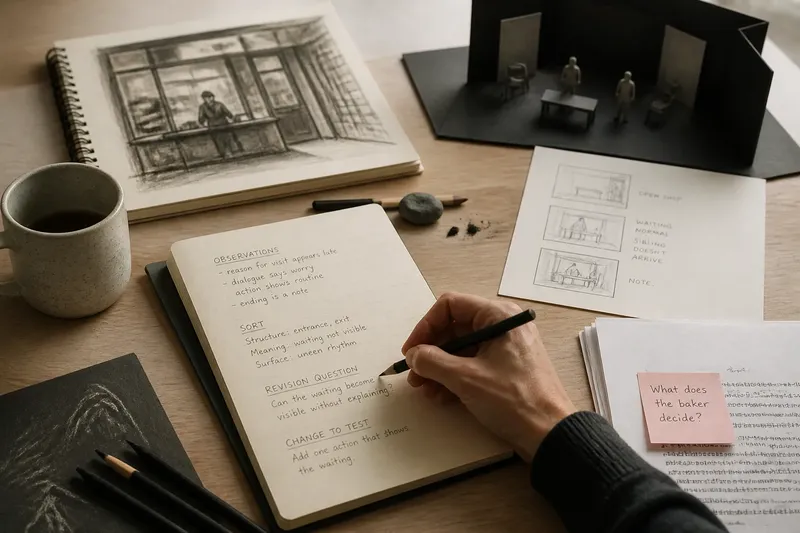
- Sort the observations. Put each note under structure, meaning, or surface. Structure concerns order and proportion; meaning concerns what the work communicates; surface concerns wording, texture, sound, or finish. If a sentence feels clumsy because its scene is misplaced, treat the note as structural.
- Select one question. Choose the observation that most affects how the whole unit is understood. For example, if a character’s decision arrives without a reason, ask what the audience needs to see before that choice. The result should be one revision question, not a bundle of unrelated edits.
- Change only what tests that question. Move a scene, alter a focal shape, or adjust a pause. Leave nearby details alone unless they prevent you from seeing the effect. You should be able to point to the specific change and say what it was meant to clarify.
- Review the whole unit again. Compare the new version with your original observation. Keep the change if it improves the whole movement; revise it further if it creates a new problem; restore the earlier version if the effect is weaker. Record the decision so you do not repeat the same uncertain adjustment.
- Name the next kind of work. Choose another structural, meaning, or surface pass, or pause if the next question is not yet clear. The observable result is a specific next action—or a deliberate decision not to edit yet.
Revision decisions
How do I know a scene needs structural revision?
If you cannot explain why a scene comes where it does, or a character’s choice has no visible setup, investigate structure before polishing sentences. Try moving or removing the scene, then read the surrounding passages to see whether the story’s movement becomes easier to follow.
What should I do with an unfinished passage?
Write down what the passage must accomplish, such as revealing reluctance or changing the balance between two characters. Leave a clear placeholder if you cannot yet find its form; return when you can judge a possible version against that purpose.
Can a rough draft already be polished?
Yes. If the wording or marks arrived cleanly, there is no need to make them deliberately messy. Inspect the choices instead: ask what changes, where attention goes, and whether the ending follows from what came before.
When should I fix a small error?
Fix it during the draft if it blocks the next decision or makes the work impossible to review. Otherwise, mark it plainly and keep going; a spelling correction or neat contour can wait while you decide what the whole piece needs.
Work through one choice
Say you have drafted a scene in which a baker closes the shop while waiting for a sibling who has not arrived. The dialogue is uneven, and the ending is a note. On a read-through, you notice that the baker talks about being worried but keeps preparing the shop as usual. Your revision question is whether the waiting can become visible without adding an explanation.
You add one action: the baker sets out a second cup, then leaves it on the counter when the sibling still does not arrive. You read the scene again from the opening. The cup gives the waiting a visible shape, but the final note still does not show what the baker decides to do. You keep the cup, because it clarifies the scene’s tension, and mark the ending as the next question. That is a useful result even though the scene is not finished: you know which choice helped and what remains unresolved.
Not every draft needs this much deliberate roughness. Trying to make a polished passage look provisional, or adding messy marks just to signal that you are still experimenting, is not worth the effort. Keep the version honest: complete enough to inspect, unfinished where a real decision remains.
Spend effort selectively
Surface work has a place. A short passage may need a careful rewrite to establish a speaker’s voice; a small area of a drawing may need detail before you can judge its contrast. The useful question is whether that attention helps you assess the larger choice. If it does, do the work. If it mainly postpones an unresolved decision, set it aside.
Before each editing session, state what you want the work to do differently. “Make the refusal understandable” is more useful than “make this smoother.” “Keep the face visible against the dark background” gives a drawing revision a clear purpose. Once the result is observable, you can decide whether the change belongs in the piece.
A rough draft is most useful when it makes the next decision visible. Treat the polished-first-pass myth as a warning against confusing finish with understanding: revise the choice that shapes the work’s effect, and let cosmetic corrections wait until they can support that choice.