The Small Collection That Gives a Draft Somewhere to Begin
A small collection of specific observations gives a vague writing idea a place to begin, with a simple way to gather details without overplanning.
A small collection of observations can give a vague writing idea a place to begin. Before drafting, gather a few details you can point to: a sound, an object, a gesture, a bit of language. They do not need to prove what the piece is about. They only need to make the subject more particular than it was in your head.
This is not research for its own sake, and it is not an invitation to wait until you have collected everything. Think of the collection as a small working surface. These six kinds of observations can help you find an opening without deciding the whole piece in advance.
1. A physical detail
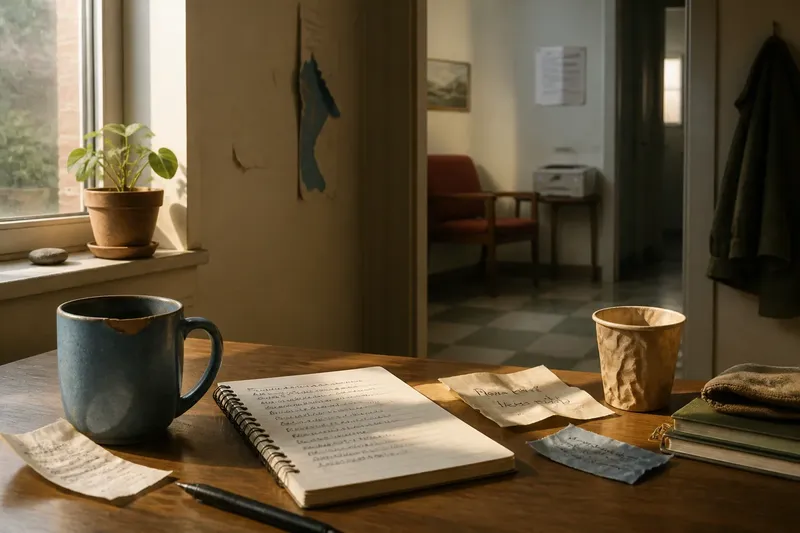
Choose one thing you can see, touch, or hear, and describe it without explaining what it means. “A chipped blue mug” gives you more to work with than “a cozy kitchen.” The mug has a color, a flaw, and a place in the room; the broad description could belong to almost any scene.
Stay close to what is observable. Note the uneven edge of a torn poster, the warm patch on a windowsill, or the double click of a latch. If you are writing from memory, mark details you are unsure about instead of quietly promoting a guess into a fact. You can decide later whether accuracy matters to the piece.
A useful detail has room around it. It can be revisited, contrasted, or connected to another observation. A chipped mug might lead toward a character who keeps using it, but you do not have to assign it symbolism before you write. Let the object earn its significance on the page.
2. A small action
Collect a gesture rather than a personality label. Someone smooths a receipt before putting it in a pocket; a person at a bus stop shifts a paper bag from one hand to the other. Actions carry timing and choice, while words like “nervous” or “impatient” tell the reader what to conclude.
For a piece about an idea rather than a scene, the action can be your own: opening a notebook, turning a page back, or stopping midway through a sentence. Describe the movement plainly. That gives you a physical starting point and may help you notice where the idea becomes difficult or interesting.
Avoid collecting gestures as clues to diagnose a real person. Treat what you see as an action, not proof of a hidden motive. In fiction, you can invent motives; in nonfiction, keep a clear boundary between observed behavior and your interpretation of it.
3. A scrap of language
Write down a phrase that catches your attention: a sign’s awkward wording, a familiar expression, or a line you hear in conversation. A phrase can bring its own rhythm and social setting. “Please close the door softly” sounds different from “Don’t let it bang,” even if both ask for the same thing.
If the words come from someone else, record only what you need and be thoughtful about context. A fragment is often enough to remind you of its sound without carrying a private conversation into a draft. For invented work, you can alter the wording freely rather than making a real person’s speech into a character trait.
Language scraps are especially useful when a draft feels too abstract. A phrase gives you a voice to answer, resist, repeat, or misunderstand. It can also reveal a tension: the wording sounds gentle, but the instruction is firm; the sentence is confident, but the speaker keeps qualifying it.
4. A contrast
Notice two things that do not quite match. A tidy desk has one damp envelope on it. A cheerful announcement comes through a scratchy speaker. A room is quiet, but a refrigerator keeps clicking. Contrast creates a small question without requiring a dramatic event.
Write both sides down before explaining the relationship. If you label the scene “lonely” or “hopeful” too soon, you may close off other readings. Keeping the details separate allows the draft to discover whether the contrast matters—or whether it is simply how the place looked and sounded.
Not every mismatch deserves a paragraph. The point is to notice where two observations make each other more vivid. If they do not connect after you try a few sentences, leave them in your collection and move on.
5. A point of change
Look for something that is different from one moment to the next: light moving off a table, a cup cooling, a line of people growing shorter. Change gives a draft a direction, even when the piece does not have a conventional plot. It lets the reader feel time passing through a concrete detail.
For a reflective essay, the change might be in your attention. You first notice the sign, then notice that its paper is peeling at the corners. That shift can become the beginning of a thought, provided you do not force it to stand for a grand lesson.
Keep the scale modest. A small alteration is often easier to write honestly than a sweeping claim about transformation. You can build outward if the material supports it.
6. A question with edges
Turn the broad subject into a question that points toward something observable. Instead of “What is belonging?” try “Who gets to choose the music in this shared room?” Instead of “Why do people remember?” ask “Which object does someone keep after clearing a desk?” The narrower question gives you a place to look and a reason to select details.
A good working question is open, but not limitless. It should allow more than one answer while making clear what kind of material might help. If the question could fit any subject, add a setting, object, person, or moment until it has some friction.
Putting the collection to work
Imagine you want to write about waiting, but “waiting” feels too broad to begin. You note the scuffed floor beneath a clinic chair, a folded paper cup, and a person checking the hallway whenever a door opens. You add the quiet interruption of a printer starting up. These observations do not establish what anyone feels or why they are there. They give you a scene to enter and choices about where to direct attention.
Now choose one detail and write a few sentences from it. You might begin with the cup, then let the hallway enter the scene. If the writing starts to explain the meaning of waiting before anything happens, return to what a person can see or hear. The collection is there to support a draft, not to dictate its message.
Keep the process light:
- Settle on a subject that still feels too broad to start.
- Gather observations from memory, a place you can visit, or an object already in front of you.
- Separate what you observed from what you infer.
- Choose one detail that raises a question or suggests movement.
- Draft from that detail, then keep only the observations that help the piece develop.
There is little value in building an elaborate archive before writing. A long list can become another way to postpone the first sentence, and extra detail does not automatically make a piece more specific. Keep only enough material to give yourself a few possible entrances.
Questions about observations?
How many observations should I collect?
Stop when you have a few distinct details and one of them makes you want to write a sentence. If every note says roughly the same thing, seek a different kind of observation rather than adding more of the same.
What if I cannot observe the subject directly?
Use a remembered detail, a familiar object, or a small action from your own experience. Mark uncertain memories as uncertain, and do not present an imagined scene as a witnessed one in nonfiction.
What if my observations do not connect?
Try writing one sentence from each detail and see which one opens the most possibilities. If none do, change the question or gather a new kind of detail instead of forcing a connection.
Can I collect details after drafting?
Yes. A draft may show you what it lacks: a sound, a physical setting, or a change over time. Add observations then, and revise only where they make the writing more precise.
A small collection is useful when it leaves you with a choice, not a verdict. For your next vague idea, look for one object, one action, and one thing that changes; then begin with whichever detail keeps calling your attention.